Is Midwest turmeric production a viable option? I attempted to tackle that question in a previous post, which you may find a helpful start for turmeric growing in non-tropical areas. However, I wanted to better understand what turmeric needs to produce well, and whether or not that was possible in a budget-friendly setup. In this post, I will provide updates on my attempts at Midwest turmeric production, along with my takeaways for the upcoming 2025 season.
2024 Turmeric Production Goals
My turmeric production goals for the year included:
- Preserve my turmeric collection through growing out all available rhizomes
- Grow higher yields of all turmeric varieties than last year
- Complete goals 1-2 with less energy costs than last year
2024 Turmeric Production Setup
In order to accomplish the above goals, I used the following setup:
- This year all turmeric was started indoors in large planters (approximately five gallons).
- Planters initially started in a grow tent with a 650W full spectrum grow light. The temperature of the ambient air was kept at 70 degrees and was raised in the grow tent through the use of a steam humidifier.
- When outdoor temperatures reached 70 degrees, plants were taken outside. When nighttime temperatures were below 50 degrees, they were taken inside. Sometimes the plants were moved outside in the afternoon only.
- Plants were taken back to the grow tent when fall temperatures dropped below 70 degrees. The temperature of the ambient was kept at 65 degrees. No humidifier was used in the fall.
Turmeric Harvest
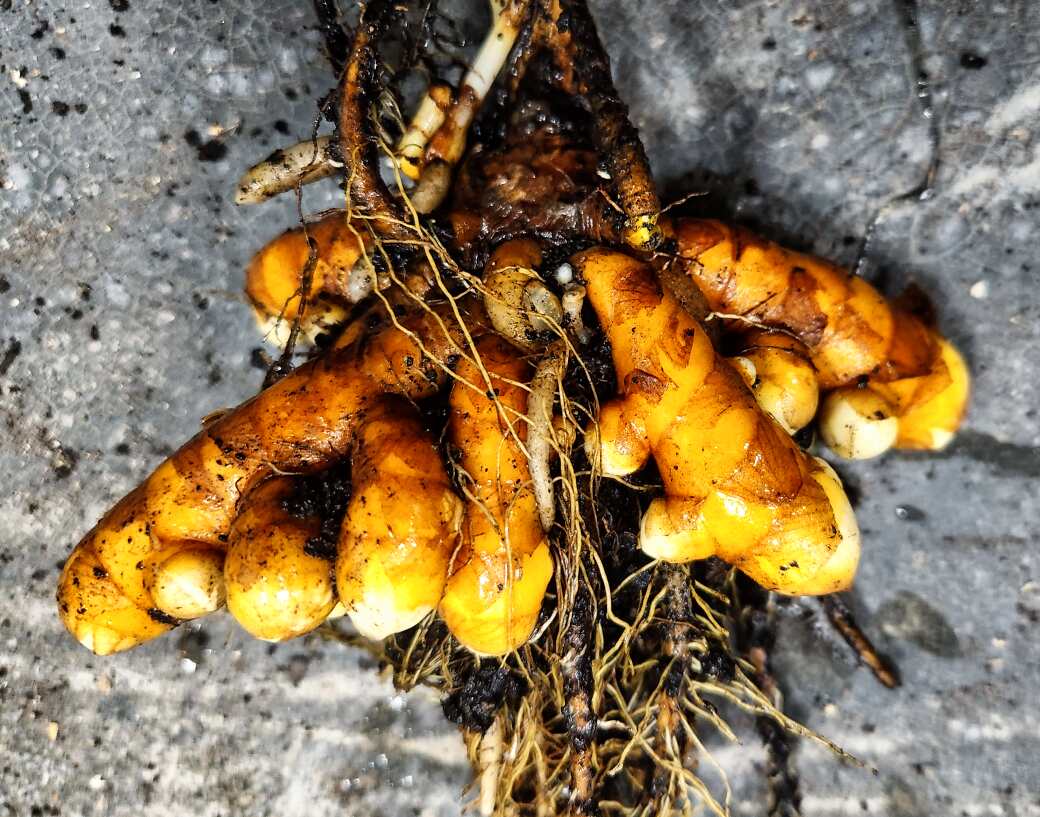
Overall, I was pleased with my turmeric harvest. Compared to last year, I had significantly more curcuma longa. This was true for my yellow, orange, and Hawaiian red varieties. Most plants produced more rhizomes and the rhizomes were larger in size than last year.
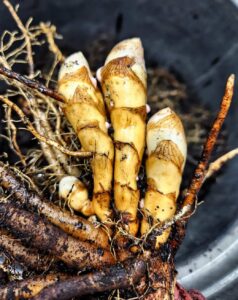
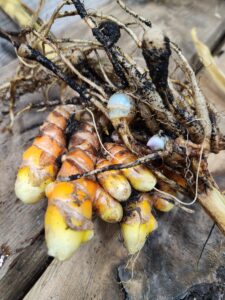
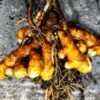
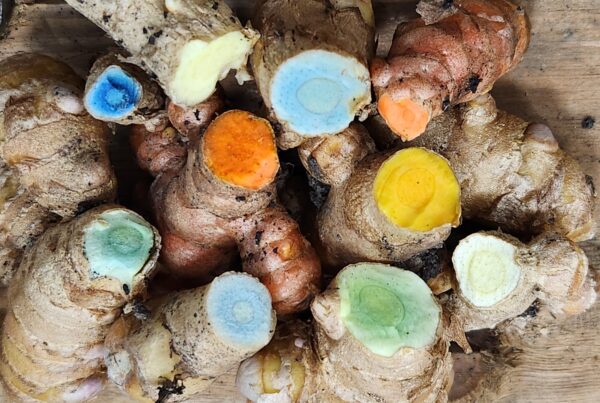
The green turmeric (supposedly curcuma longa as well) also fared better than last year. However, it is notable that last year’s green turmeric harvest was minimal. The green turmeric rhizomes (below) were less numerous than the Hawaiian red (above), although they produced some good-sized mother roots that should positively impact next year’s crops.
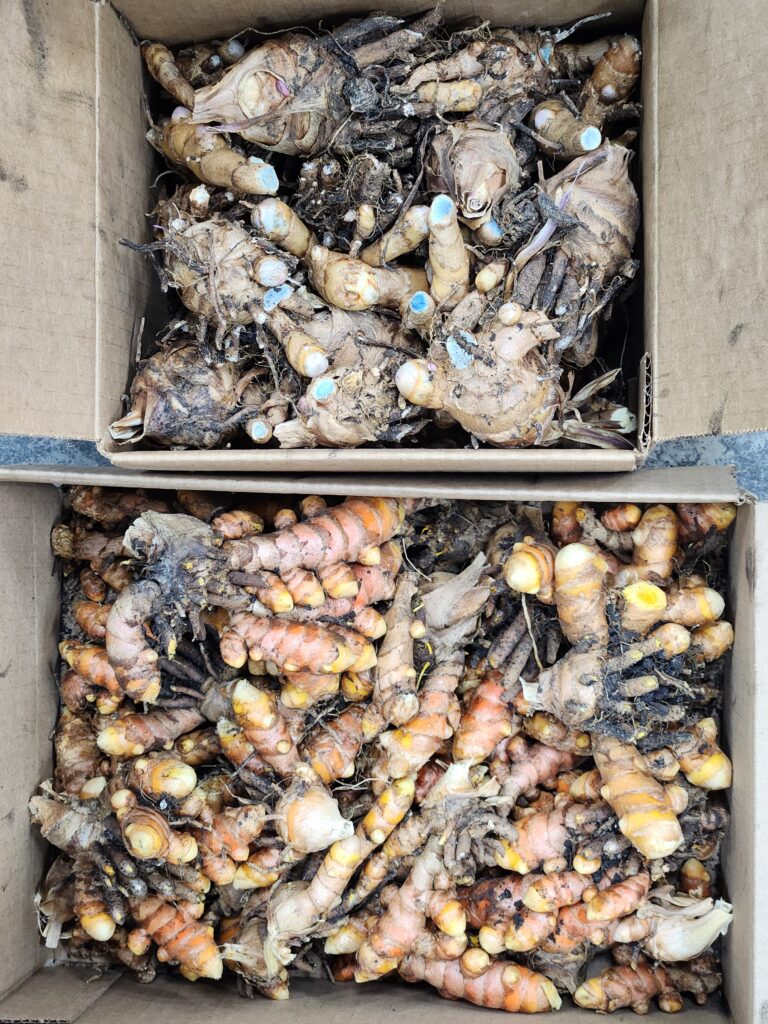
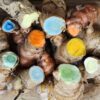
The curcuma caesia did not seem impressed with this year’s conditions. Despite having more room to grow, the cooler temperature this year was likely detrimental to caesia’s production (below- see the tiny blue rhizomes compared with the orange rhizomes). Of note, although many blue and black rhizomes were small, they also produced nice-sized mother roots and I am hopeful for next year.
I only had one mango ginger (curcuma amada) and one black ginger (kaempferia parviflora) rhizome to plant last year. Both survived the season and produced additional rhizomes. I hope to learn more about their cold-hardiness this upcoming planting season.
Key Turmeric Takeaways
This upcoming season I will grow the orange and red turmeric (curcuma longa) similarly. It produced well in larger pots with relatively cool temperatures. However, I will create a new setup for the blue and black turmeric (curcuma caesia), giving it more heat and humidity. I am hopeful this will help me ramp up production of these medicinal rhizomes. I will likely try the green turmeric in the same setup as the blue and black turmeric to see if that leads to increased yields.
Growing turmeric in a cool climate is not without its challenges, but I am encouraged that it is possible and may even be profitable once our greenhouse is up and running.
Have you tried growing turmeric in the Midwest (or somewhere else with cold winters)? I’d love to hear about your experience!



Glad to hear the plants are doing well! We had a week of snow last winter and I think I lost some of the red Turmeric I found to grow, but the blue starts I had gotten last year seam to be doing well and the green is huge. I covered all the pots with AG. Fabric and kept them in the greenhouse to over winter. Finger crossed for harvest time this year.
Still looking for Black and some of the other colors.
Andrea
I’m glad to hear that many of your turmerics are doing well also and would love to know how the greenhouse impacted them.
I should have a decent crop of red late this fall/early winter. We’ll see about yellow/blue/black. Thanks for checking in!
The Turmeric sold to me was blue, but I’m calling it green. Experimented with one plant in full sun (SW Missouri) and got noticeable better harvest. Leaves were smaller and more of them, than the shaded plants, but more rhizomes. Same thing with the Galangal. Moving all to full sun next year. The Ginger was not happy with that amount of sun and did fine in a more shady spot.
Nice place place here and learning a lot!
There seems to be quite a bit of overlap with what is sold as “blue” and “green.” After several years of growing, I’ve come to the conclusion that green turmeric is likely a variant of blue/black turmeric (curcuma caesia). Genetic testing could certainly prove me wrong, but it’s my current view.
Yes, I’ve also noticed that they like full sun in the Midwest. They can burn a bit in full sun in hot climates, but where both of us are, full sun seems safe (and often times better). Thanks for sharing your observations!